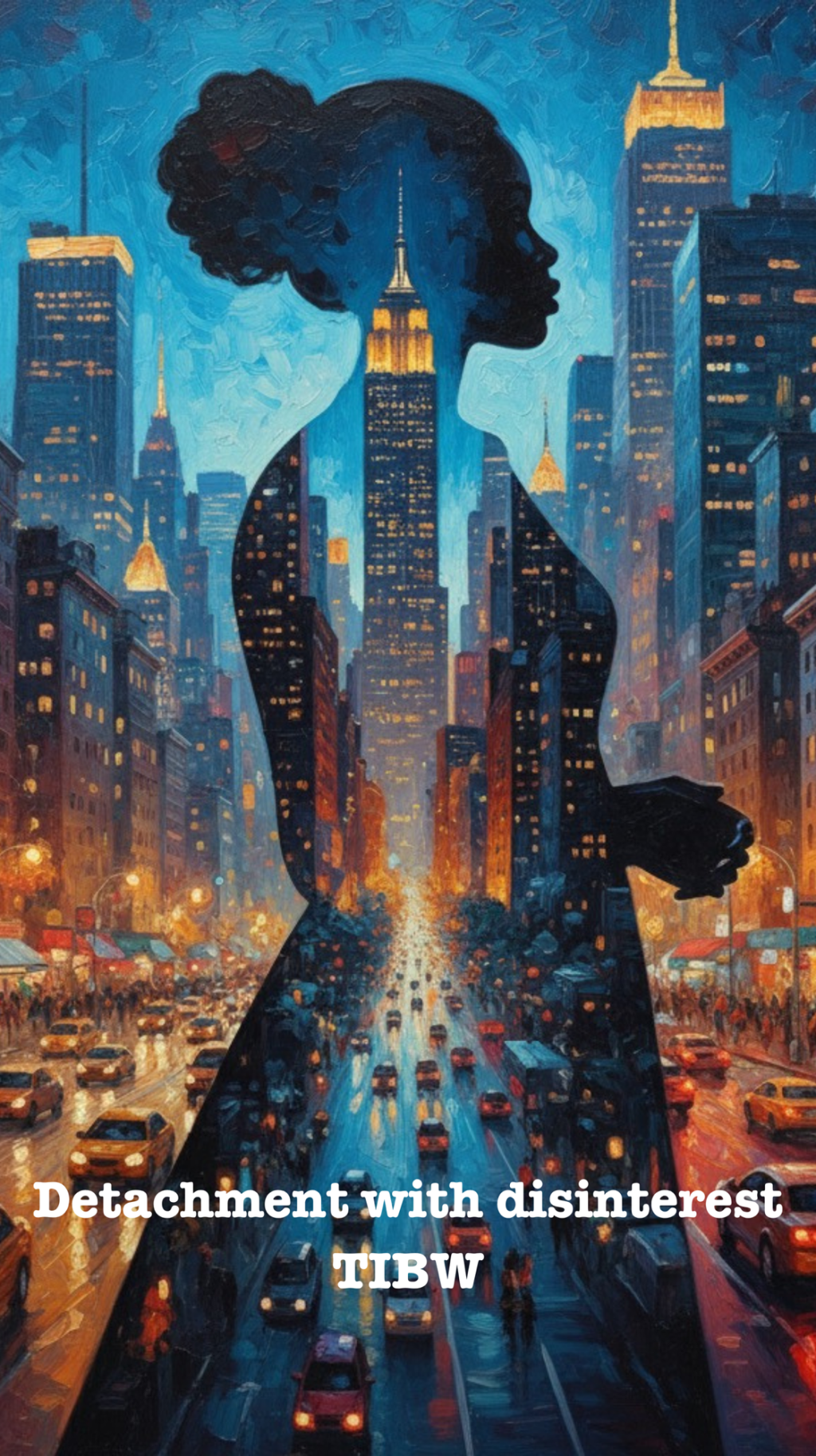
There’s a subtle, sacred power in learning to let things unfold without constantly feeling responsible for fixing them. For many of us, that’s a hard lesson to learn. We’ve been conditioned to be in it all the time: to care deeply, carry heavily, and never step back. To stay attached, because distance has been misnamed as detachment, and detachment as disinterest.
Detachment isn’t disconnection, it’s discernment. It’s knowing when something has demanded too much of you for too long, and deciding that your peace deserves priority. It’s the moment you stop asking, How do I make this work? and start asking, Is this even worth the work?
We are taught that love means closeness, that caring means involvement, and that commitment means always being “on.” But what if love could also look like space? What if caring could include boundaries? What if commitment meant protecting your energy enough to show up whole?
That’s detachment.
It’s not about coldness; it’s about clarity. It’s about choosing to remain grounded even when everything around you tries to pull you into reaction. It’s the strength to stand still while chaos dances in circles around you. It’s the courage to say, “This no longer deserves a front-row seat in my spirit.”
When people are used to your over-involvement, your detachment will feel like rejection. But that’s not your responsibility to fix. Their discomfort is just evidence of how accustomed they were to your availability.
For Black women especially, detachment becomes survival. We’re told that our worth is tied to our usefulness, that being “strong” means being accessible, empathetic, and endlessly giving. But there’s a fine line between compassion and codependence. Between being present and being consumed.
Detachment doesn’t mean you don’t care, it means you finally understand what’s yours to carry and what’s not. It means you can love someone and still say, “This energy isn’t healthy for me.” It means you can show up in the world without surrendering yourself to it.
And that, my love, is freedom.
Sometimes detachment looks like silence. Not because you have nothing to say, but because peace doesn’t need defending. Sometimes it looks like declining the invitation to argue. Sometimes it looks like walking away from a job, a friendship, a dynamic that no longer serves you… and doing it without the need to be understood.
Because the more you detach from what drains you, the more space you create for what sustains you.
Let people misinterpret it if they must. Let them call it distance, arrogance, or indifference. You know better. You know it’s protection. You know it’s peace.
Detachment doesn’t mean abandoning empathy, it means anchoring it. You can still wish them well. You can still love them from afar. You can still hope for healing without needing to hold their pain.
That’s what maturity looks like. That’s what evolution sounds like. It’s not a slammed door, it’s a quiet boundary.
So if your spirit is whispering that it’s time to step back, listen. You don’t owe anyone an explanation for choosing stillness over struggle. You don’t have to apologize for reclaiming your energy from the places that misused it.
Detachment isn’t disinterest, it’s balance. It’s you saying, “I can care without carrying it all.” It’s you realizing that your peace doesn’t need to be proven through proximity.
Today, practice being present without being pulled. Observe without absorbing. Care without clinging.
Because when you master detachment, you start to move through the world lighter, clearer, freer. You realize that love doesn’t always mean closeness, and peace doesn’t require permission.
You can love people and still let them go. You can honor connections and still honor your own capacity.
Don’t confuse detachment with disinterest.
Because peace doesn’t make noise (but it does make sense).
Until next time, I wish you nothing but sunshine, rainbows, and unicorns, which are no less fictitious than the phenomenal creature you are.
 The Invisible Black Woman
Leave a comment