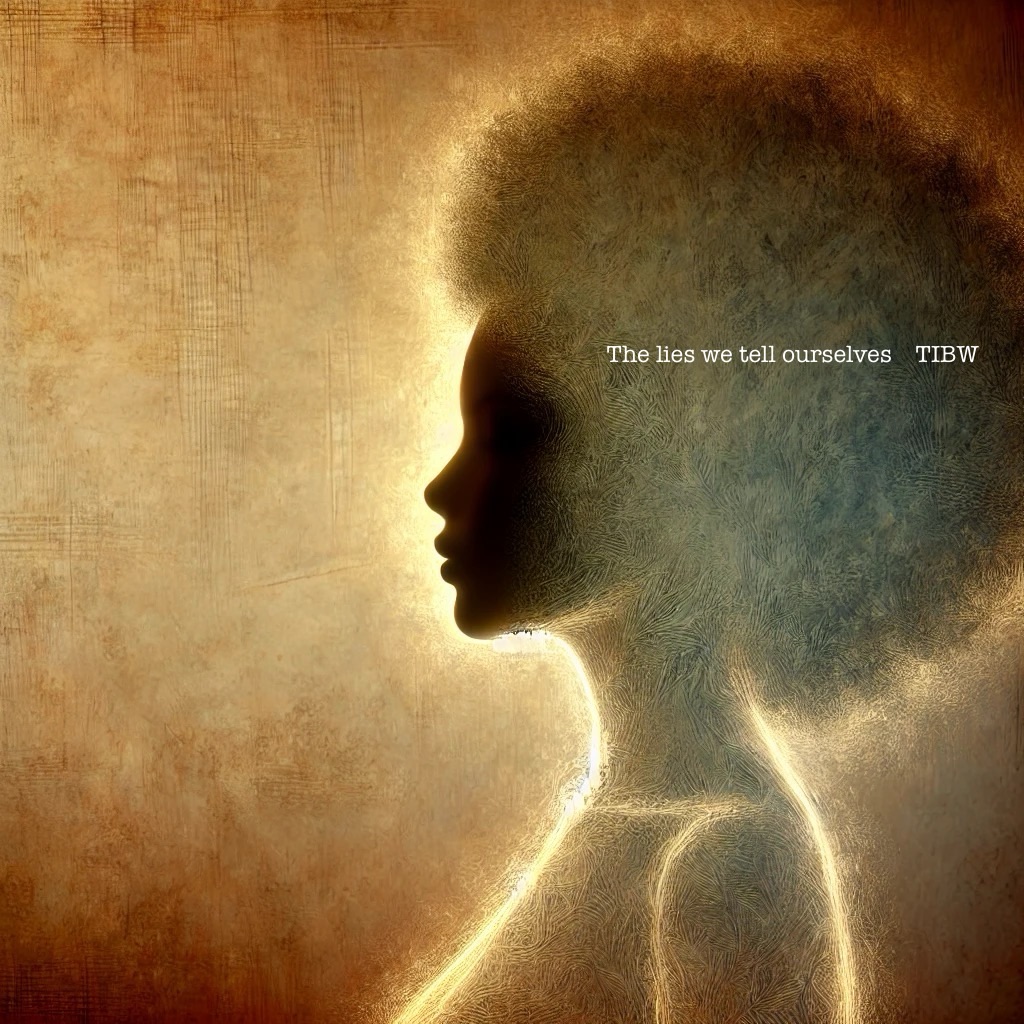
After the break, group got heavy. We peeled back layers, exposing those core beliefs that sit in the mental dark corners, whispering repeatedly, “You’re not enough.”
It was a hard truth that landed like lead balloon when one of us spoke it aloud: “Why does it feel like, no matter what, I’m just… wrong?” Her voice carried a mix of frustration and fatigue, a blend too familiar for anyone in that room. We all knew that sting, that quiet despair wrapped in self-doubt.
One voice broke the silence. “It’s hard, isn’t it? To believe you’re valuable, especially when the mirror in your head’s been cracked by everyone else’s opinions. Makes you wonder if what you’re seeing is you or just their fragmented version of you.”
Another chimed in, and this time, you could feel the ache in her words. “It’s like I’ve spent a lifetime convincing myself I’m broken. When other people say it, it hurts. But when I say it? I believe it. It’s like I don’t know any other way to see myself.” We all felt the weight of rehearsing those lines, of taking on the worst opinions of others until they meld into some version of “truth” that feels impossible to shake.
Someone else shared, “It’s like there’s something in me that’s fundamentally off. Like, sure, I’ve survived a lot, but now? I feel like I’m just existing in this… shell of survival mode. How do I even start to live?”
As their words settled, I felt a familiar dissonance simmering inside me, that sense of walking between worlds—being in spaces that demand “perfection” while I’m deep in the thick of figuring out what “okay” even looks like. In corporate America, vulnerability is nothing but a checkbox. “Bring your whole self to work” sounds great in theory, but the unspoken rule is clear: leave the messy, vulnerable parts outside. Your job doesn’t want your struggle; it wants your performance.
We exchanged stories of trying to keep it all together, of hitting “mute” on our own crises to nod along in yet another meeting about “synergies” and “alignment.” Meanwhile, the real work—unlearning years of internalized shame and rewriting the narrative that told us we were broken just for feeling too much—went unacknowledged.
Carrie, who was leading the session, dropped a question that silenced the room. “What if, instead of ‘What’s wrong with me?’ we asked, ‘What happened to me?’”
The silence was loud, collective. Shifting the blame from “Who I am” to “What I experienced” felt like taking off a layer of armor we’d worn for too long. But that’s a grace we don’t often get outside of these rooms. At work, there’s no time for grace, no acknowledgment of what it takes just to show up. In those spaces, your worth is pinned to your productivity, not the inner battles you wage daily.
A woman murmured, “It feels like trying to purge this thick scar tissue I had to build up just to survive. But now it’s holding me back. Like, I want to reach that girl I was before… but she’s buried too deep.” And I knew exactly what she meant. We all did.
That scar tissue—those thick, unseen layers we’ve had to build just to move through the world? In corporate America, there’s no PTO for tearing that down. There’s no “mental health milestone” to put in a performance review. You’re expected to just keep moving, task to task, project to project, with barely a second to acknowledge the weight you carry. But life doesn’t work that way, and neither does healing.
Then someone else added, “I think the hardest part is valuing other people more than ourselves. We treat them with care, empathy, understanding, but when it comes to us? We’re ruthless.” The truth hit like a punch. How many times have I buried parts of myself to seem “normal” at work? How many of us have crumbled under the pressure to be polished, professional, put-together? How many times have we silenced our own pain just to keep a job that barely acknowledges our humanity?
Sitting there, surrounded by people all navigating their own journeys, it became clear that healing isn’t linear. It’s not about a tidy resolution. But maybe, in spaces where vulnerability is treated like weakness, we’re stronger than the systems that try to contain us.
So here’s the truth, stripped of niceties: we can’t keep breaking ourselves down to fit into boxes that were never meant for us. Maybe it’s not about fixing ourselves to meet their impossible standards but about redefining the standards entirely. And if that makes us unfit for certain spaces, so be it.
Because there’s power in embracing the “messy,” in honoring the scars and layers that make us whole. If the world isn’t ready to make space for that? Then it’s the world that needs to catch up.
This is what I tell myself today when I’m ready to stand on business and ten toes down on who I am. The jury’s out on how confident I’ll be of this tomorrow…
Until next time, I wish you nothing but sunshine, rainbows, and unicorns, which are no less fictitious than the perfectly imperfect you are.
 The Invisible Black Woman
Leave a comment