Seven surgeries. Seven. Every single one with the hopes that this time would be different. That this time would be the last. My first one came at the ripe old age of 18, when most people are thinking about college, finding their first real job, or taking a gap year to find themselves. Me? I was finding out that pain, real pain, had levels. My body, for reasons that still frustrate me to no end, decided that 18 was the perfect time to go haywire. And, as it turned out, it was only the beginning.
Seven surgeries on the exact same issue. Nerve damage, tissue and muscle that never healed or quite grew back the way they should have. Chronic pain became the uninvited friend, cousin, aunt, or uncle that refused to leave, no matter how hard I tried to send it on its merry way.
I was nowhere close to grown when I first learned what it meant to live with chronic pain. And I wouldn’t wish it on my worst enemy. You start to question everything about yourself—your body, your strength, your ability to just deal with it. There were days the pain was so excruciating I would pray through tears that God would put me out of my misery.
As intense and very real as it is, at first, you try to deny it. You tell yourself that it’s temporary. That the pain will go away eventually, if you just do the right things—the latest juice cleanse, sleep more, physical therapy, acupuncture, massages, yoga. You do everything that’s recommended, and still, the pain just straight trolls you.
Then, eventually, you move through all the stages: from denying it exists to being angry you’re dealing with it, to bargaining, compromise, then full acceptance. Living with chronic pain becomes your new normal. And it can be difficult for healthcare providers who are not used to dealing with patients that live with chronic pain to fully appreciate how your pain level can be at a 10 and no one would ever know. You are forced to function and exist and live through the pain. They do not understand that most of us have a pain scale that is really more from 0 to 100, and we only ever seek help when it’s five to ten times past that, when we absolutely cannot do for ourselves. Sometimes I wish that there was a way for pain to be measured precisely with a blood test. Not all doctors and nurses take your word for it, unfortunately.
I’ve talked about my dark passengers before, as depression and anxiety, but pain is also along for the ride (sometimes it’s the one driving while I’m in the trunk in a fetal position). It never ever gets out of the vehicle. At least there are peaks and valleys with the other two. Persistent pain is just measured by whether you are doing enough on a particular day to distract yourself or if it’s not so debilitating from one moment to the next that you can get through the day. But it never truly ever goes away. It’s always lurking, like the world’s most annoying and unbearable fungus.
I’ve had years to come to terms with it. And even still, despite my coming to terms with it or accepting it, if you will, it is full-on aggravating to know that this will be as good as it gets.
So sitting across from hubby, watching him as he was processing the news that he was now the proud owner of a chronic condition, I cried on the inside. I didn’t want this for him. I didn’t want it for us. And I know there are worst things, right? We had been here three years ago when they told us his heart was failing because between the clot and his uncontrolled high blood pressure, his heart was working overtime. But we knew that with the right medication and a better diet, we could turn things around. And we had. Earlier this year we got the news from the cardiologist that his heart failure was all but reversed and he wouldn’t need to be back for another year. We were over the moon. We had done all the right things, and the reward was a heart that was no longer on the brink.
And now this. It felt like we had taken all these leaps forward and in one blink, we got knocked back to square one. What a cruel joke. What’s worse is that this time, the new clot didn’t just bring a friend, but a whole damn house party. We were facing a long road, but I never thought this blip would be a “lifelong” one.
It gutted me. Not just because I love him and hate to see him suffer, but because I know what it’s like to live with something that never goes away. I know the mental toll it takes, the physical exhaustion, the constant battle between pushing through and lying face down in the bed because you just cannot can.
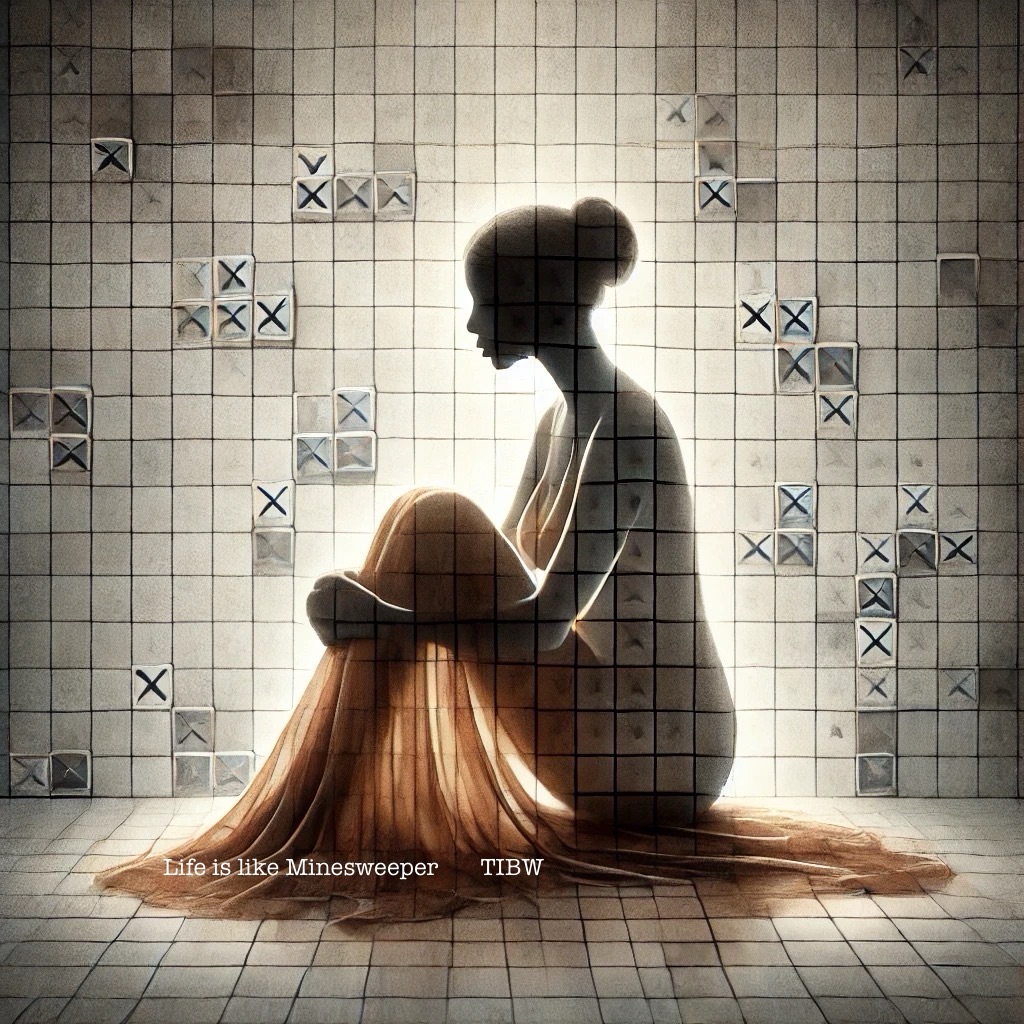
It made me think about that Forest Gump phrase. You know the one about life being like a box of chocolates? Well, I see that and raise it to life being like a game of Minesweeper. More than half of you likely won’t get that reference because it’s well before your time. What the hell is Minesweeper, you ask? One of the first games that was included on all personal computers along with Solitaire (now I’m really showing my age!). The game is simple: you’ve got a large gray grid filled with small squares, and the goal is to click on the squares without hitting a mine. You start hitting your stride and are feeling like you’re going to clear the entire field, then BAM! You’ve hit a mine and it’s game over.
Life feels a lot like that sometimes. We’re all just plugging along, “clicking” away, hoping that we won’t hit the mine. And even if you’ve got your entire family tree mapped out, even if you’ve spent years reading up on every potential health issue, you still have no idea what’s lurking beneath the surface. You don’t know what genetic predispositions are waiting for you, what invisible landmines you’re going to trip over, or when they’ll show up.
I certainly didn’t see mine coming at 18. Hubby didn’t see his coming either. But there they were, our respective mines, waiting for the most inconvenient moment to do what they do best and leave you picking up the pieces.
And so, we live with it. We keep clicking, cautiously at first and for a while after, because once you’ve hit a mine, you know how fragile everything is. How quickly it can all change. But you still have to keep playing because what other choice do you have?
I remember telling hubby on one particularly bad pain day that I couldn’t honestly remember the last time I had a pain-free day. And I wasn’t saying that to be dramatic or in jest. I truly could not remember when that was.
BUT—yes, there is one—BUT, he and I ain’t really special, are we? In fact, if we were to really put a count to the population size of our fictitious town of Chronicville, I’d bet the number is really quite staggering. It’d be probably easier to count the nonresidents. And that’s kinda important because the entire point of this share was not for any one of us that live here to throw our hands up and cry to the heavens (although a good cry can be oh so cleansing) and just give up. The real point is that we find ways to adjust to the new normal. We adapt, we tweak, we refine. That’s the beauty of choosing to define your life despite the pain or the condition rather than let it define you.
I know it’s gonna take some doing and it’s not at all gonna happen overnight, but hubby and I will get there. We’ll buy enough clotting gauze to fill a factory. I’ll insist he avoid the use of sharp objects and I’ll baby him a ton a bit and he’ll put up with it because he knows it’ll give me peace of mind. But the most important thing we’ll both do is live. Because although life may be like a game of Minesweeper, it also often is like a box of chocolates: absolutely positively sweet and worth savoring.

 The Invisible Black Woman
Leave a comment